-
Whatsapp: +86 15938761000
-
Email: likang@shconcretemixer.com
-
Address: Shenglong Youyi City, Zhongyuan District, Zhengzhou City, Henan Province
-
Whatsapp: +86 15938761000
-
Email: likang@shconcretemixer.com
-
Address: Shenglong Youyi City, Zhongyuan District, Zhengzhou City, Henan Province
What Is a Trailer Concrete Pump?
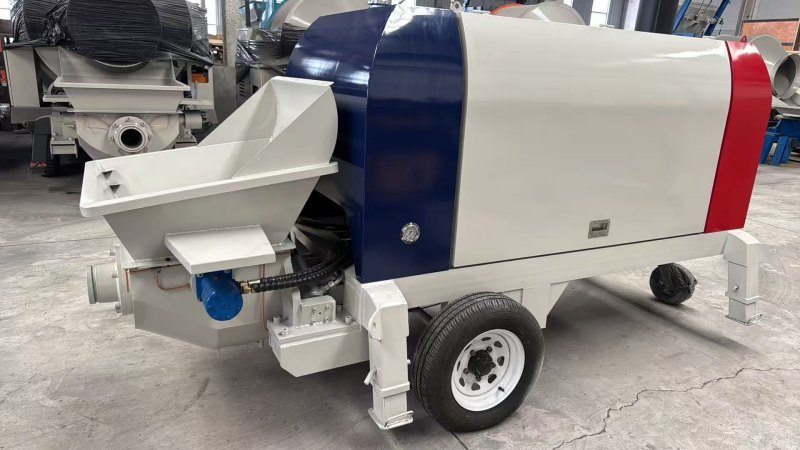
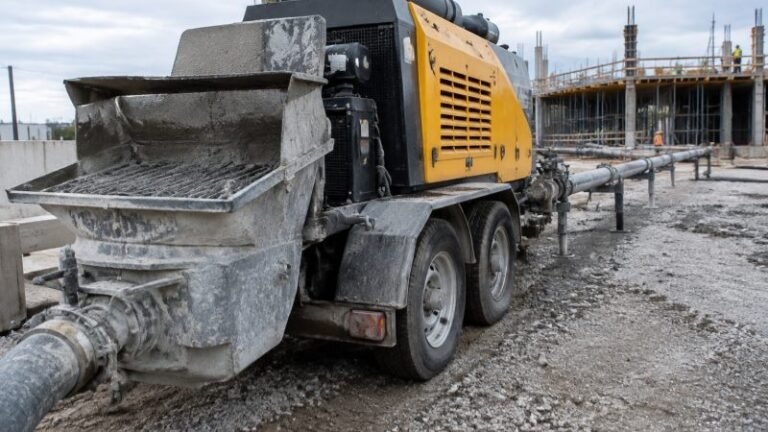
A trailer concrete pump is a stationary, towable machine mounted on a single- or twin-axle trailer chassis that pushes liquid concrete from a mixer truck to a pour site through connected steel pipes and rubber hoses. Because it has no driving engine of its own, you tow it to the job site—compact units hitch right behind a pickup or utility truck, while heavier high-pressure models need a medium-duty truck or flatbed—drop the outriggers to stabilize the frame, and pump concrete horizontally or vertically into spots a mixer truck can’t reach.
According to Research and Markets, the global trailer-mounted concrete pump segment is projected to grow from $3.5 billion in 2025 to $3.76 billion in 2026. Contractors keep buying them for a straightforward reason: you get serious pumping pressure across residential, commercial, and heavy civil jobs without paying truck-mounted boom pump prices.
How Does a Trailer Concrete Pump Work?
A trailer concrete pump uses a twin-cylinder hydraulic piston system and an S-tube transfer valve to pull liquid concrete out of a hopper and force it continuously down an external pipeline.
Everything runs on synchronized hydraulic strokes so dense, abrasive concrete stays moving instead of stalling in the line:
- Concrete Loading: A transit mixer dumps fresh concrete into the rear hopper, where a rotating agitator shaft keeps the mix turning so the aggregate doesn’t settle or segregate.
- Suction Stroke: The first hydraulic cylinder pulls its concrete piston back, creating suction that draws concrete from the hopper into the material cylinder.
- Discharge Stroke: At the same time, the second hydraulic cylinder drives its piston forward, pushing the concrete already in that cylinder through the S-tube valve and out into the pipeline.
- Valve Switching: Once the pistons hit the end of their stroke, a hydraulic swing cylinder snaps the S-tube valve over to the freshly filled cylinder. Both pistons reverse, keeping a steady flow going down the line.
Before you send the first yard of structural concrete through, you have to lubricate the inside of the pipes—a step called priming. Ask most experienced operators and they’ll tell you that priming with a cement-and-water grout slurry beats relying on chemical slick packs alone, especially if you’re running older rubber hoses with worn inner linings.
Main Types of Trailer Concrete Pumps
Trailer concrete pumps are grouped two main ways: what powers them (diesel or electric) and how much concrete pressure they generate (standard or high-pressure). What you pick depends on site utilities and how much vertical or horizontal resistance you’re pushing against.
Diesel vs. Electric Trailer Concrete Pumps
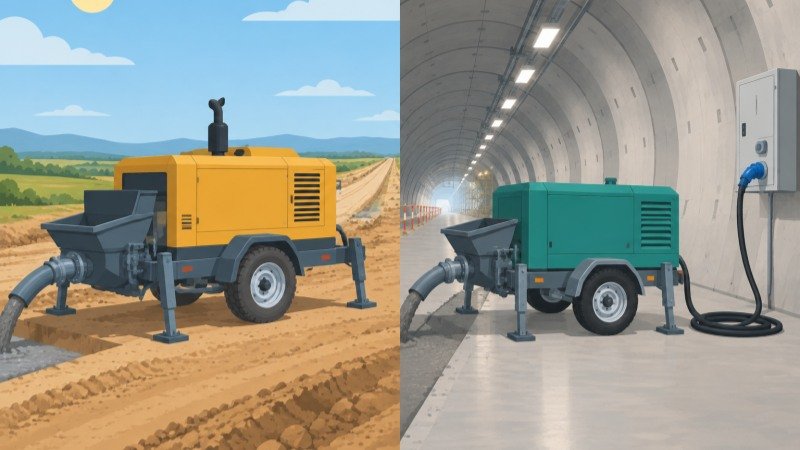
Choosing between diesel and electric usually isn’t complicated—it’s dictated by what power is available on site and what local inspectors will let you run.
| Feature | Diesel Trailer Concrete Pump | Electric Trailer Concrete Pump |
| Power Source | Self-contained diesel engine | 3-phase industrial electrical grid or generator |
| Primary Advantage | Works anywhere without external power | Lower running cost, quieter, zero exhaust emissions |
| Best Suited For | Remote sites, rural roads, early-stage civil works | Indoor pours, urban zones, tunnels, long-term high-rises |
| Operating Considerations | Needs fuel supply; engine power drops 8%–12% per 1,000 m of elevation | Needs stable high-voltage power on site |
According to Persistence Market Research, diesel-powered units still make up roughly 68% of the broader global concrete pump market because crews can’t always count on site power grids—and off-grid trailer pumps follow that same pattern. That said, electric models are the fastest-growing segment as urban centers across Europe and Asia tighten zero-emission and noise rules.
Standard vs. High-Pressure Trailer Concrete Pumps
Standard trailer pumps typically run between 6 and 13 MPa of concrete pressure, which is plenty for residential foundations, slabs, and low-rise buildings. High-pressure models push 16 MPa to over 22 MPa, using heavy-duty chrome-plated delivery cylinders and reinforced hydraulics. You need that extra muscle to overcome the massive head pressure and line friction on supertall towers and long-distance tunnel linings.
Trailer Concrete Pump vs. Boom Pump and Line Pump
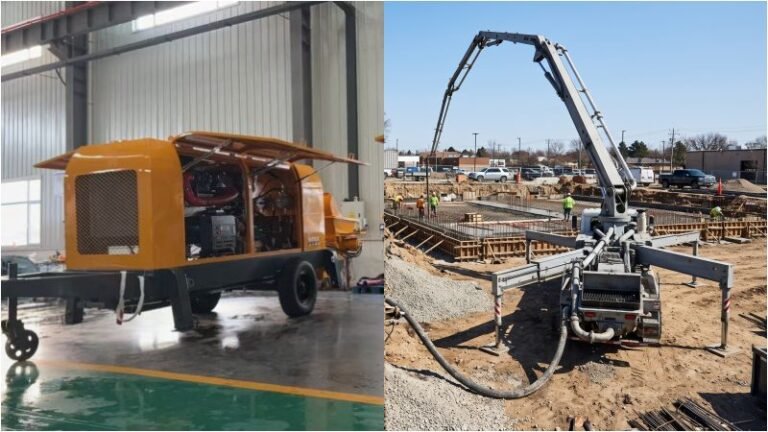
A trailer concrete pump is a towable, ground-based unit feeding manually laid pipes; a boom pump is a self-propelled truck with an articulated robotic arm; and a truck-mounted line pump is a self-propelled truck without a boom.
Job-site terminology overlaps a lot here, which trips people up. In North America, crews call almost anything pumping through ground hoses a line pump, whether it sits on a trailer or a truck chassis. Manufacturers, on the other hand, often label trailer pumps as stationary or static pumps because the machine stays planted in one spot while you pour.
| Comparison Factor | Trailer Concrete Pump | Truck-Mounted Line Pump | Boom Pump |
| Mobility | Towed by a separate truck | Self-propelled truck chassis | Self-propelled truck chassis |
| Delivery Method | Manual steel pipes and rubber hoses | Manual steel pipes and rubber hoses | Remote-controlled articulated arm |
| Setup Space Needed | Minimal (compact footprint) | Moderate | Large (wide outrigger span + overhead clearance) |
| Output Volume | Low to medium (20–90 m³/h) | Low to medium | High (100+ m³/h) |
| Capital Cost | Lowest | Moderate | Highest |
Where Are Trailer Concrete Pumps Used?
Trailer concrete pumps earn their keep on sites where overhead obstacles, tight access, or long pumping distances rule out mixer trucks and boom arms.
Because you can snake a pipeline through doorways, around corners, and straight up elevator shafts, these pumps show up on very different kinds of jobs:
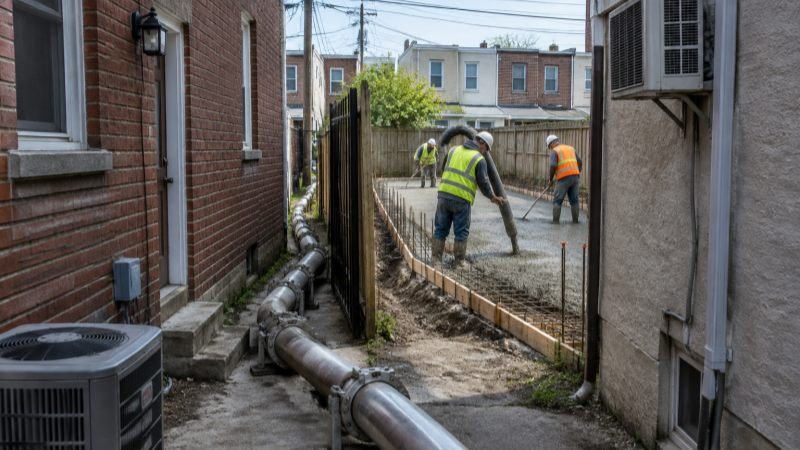
- Residential and Tight Urban Sites: Pouring backyard swimming pools, basement slabs, driveways, and infill housing where narrow alleys or overhead power lines make unfolding a boom impossible.
- High-Rise Construction: Pumping structural concrete straight up through fixed riser pipes built into the tower core. On extreme supertall builds, contractors step up from standard towable units to heavy-duty stationary high-pressure pumps built on the same hydraulic architecture. During the construction of the Burj Khalifa in Dubai, Putzmeister stationary high-pressure pumps set a world record by pumping vertically to 606 meters. To keep the concrete from setting up early under extreme pressure and desert heat, engineers batched ice flakes straight into the mix to hold the temperature down.
- Tunnels and Underground Civil Works: Moving concrete deep into tight mountain passages and underground shafts where large trucks can’t turn around. Electric trailer pumps are especially well-suited here, delivering continuous concrete flow for tunnel linings and structural supports without filling confined spaces with diesel exhaust.
- Bridges, Dams, and Remote Infrastructure: Running concrete over rough terrain or water crossings where parking a heavy boom truck isn’t safe or practical.
How Far Can a Trailer Concrete Pump Reach?
A standard trailer concrete pump typically pushes 100 to 300 meters horizontally and 30 to 100 meters vertically, while heavy-duty towable high-pressure models can exceed 1,200 meters horizontally and 260 meters vertically (with specialized stationary high-pressure setups pushing past 600 meters vertically on supertall projects).
First-time buyers get burned all the time by taking a spec sheet’s theoretical maximum pumping distance at face value. Those numbers assume ideal conditions: straight steel pipe, textbook slump, and sea-level air density. Out on an actual job site, three things cut your real reach down fast:
- Rubber Hose Friction: According to the American Concrete Pumping Association (ACPA) Certified Operator Study Guide, rubber delivery hose creates three times the pumping resistance of steel pipe—so 3 meters (10 feet) of rubber hose drags on the pump like 9 meters (30 feet) of steel pipe. Run rigid steel pipe as close to the pour as you can, and keep the flexible end hose short.
- Concrete Mix and Slump: Concrete with a slump between 120 mm and 200 mm moves cleanly through the line. Drop below 100 mm, and internal friction spikes enough to cut your effective pumping distance by more than 30%. Smaller 65–75 mm (2.5- to 3-inch) lines also demand proper pumpable mixes with enough fine aggregate, or you’ll plug the line almost immediately.
- Elbows and Bends: Every 90-degree elbow you clamp in to get around a corner adds serious friction loss and eats directly into your total horizontal or vertical reach.
Advantages and Limitations of a Trailer Concrete Pump
Trailer concrete pumps give you a low buy-in, a tiny footprint, and long-distance reach, but you pay for it in manual pipe-handling labor and strict job-site safety risks.

Key Advantages
- Lower Capital Investment and Faster ROI: You’re paying a fraction of the purchase price, insurance, and chassis upkeep of a boom truck. For small-to-medium contractors, owning a trailer pump wipes out recurring pump rental bills—which on full-day commercial pours or boom rentals in North America often run $1,300 to $1,800 per pour, and even smaller line-pump rentals add up quickly—giving you a fast payback.
- Access to Restricted Spaces: Only the hose goes into the pour zone. Crews can place concrete inside existing buildings, under low bridges, and across steep slopes without tearing up finished ground with heavy trucks.
- Simpler Mechanical Maintenance: There’s no multi-section hydraulic boom or commercial truck drivetrain to babysit. Routine maintenance stays focused on wear parts—wear plates, cutting rings, and pistons—plus the main engine or motor.
Practical Limitations and Safety Risks
- High Labor Intensity: Carrying, clamping, breaking down, and washing out hundreds of meters of heavy steel pipe and concrete-filled rubber hose takes real crew hours and physical grit before and after every pour.
- Lower Placement Speed: On wide-open commercial pours like warehouse slabs or massive mat foundations, a trailer pump simply won’t keep up with the m³/h placement speed of a big boom pump.
- Hose Whipping Hazards: Safety bulletins from the American Concrete Pumping Association (ACPA) warn that trapped air pockets in the line can trigger violent hose whipping when pumping restarts—a serious injury or fatality hazard for anyone holding the end hose.
Operational Note: Before you buy a trailer concrete pump, check local availability for wear parts and hydraulic service first. Daily wear items add up fast, and a breakdown halfway through a scheduled pour turns into expensive wasted concrete.
Conclusion
A trailer concrete pump isn’t built to replace a boom truck on massive, wide-open slabs—it’s built to get concrete into tight, obstructed, or long-distance pours without tying up your capital in a heavy truck chassis. As long as you match the pressure rating, power source, and pipeline setup to your actual job-site conditions rather than relying on spec-sheet maximums, it’s one of the most cost-effective workhorses a contractor can own.
If you’re sizing up concrete pumping equipment for an upcoming job and want help matching output capacity, pressure ratings, and power setups to your site, contact us to speak with an equipment specialist.