-
Whatsapp: +86 15938761000
-
Email: likang@shconcretemixer.com
-
Address: Shenglong Youyi City, Zhongyuan District, Zhengzhou City, Henan Province
-
Whatsapp: +86 15938761000
-
Email: likang@shconcretemixer.com
-
Address: Shenglong Youyi City, Zhongyuan District, Zhengzhou City, Henan Province

What Is an S-Valve in a Concrete Trailer Pump?
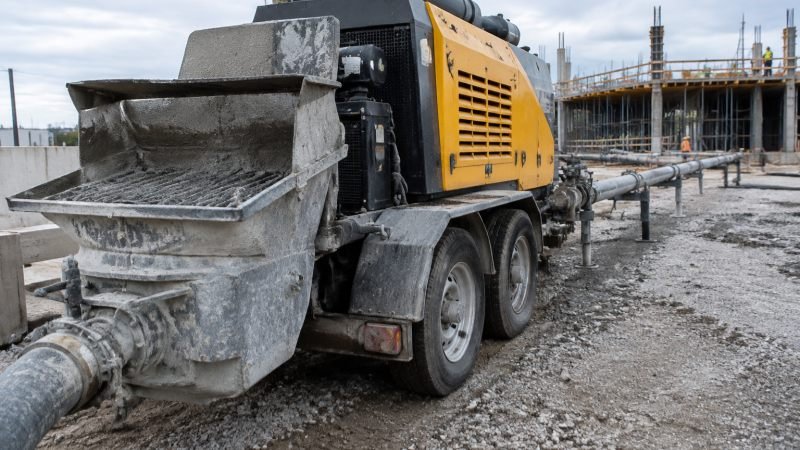
An S-valve (also called an S-tube or swing tube) is a heavy-duty, S-shaped cast steel distribution valve mounted inside the hopper of a twin-cylinder hydraulic concrete trailer pump. It swings back and forth between two reciprocating pumping cylinders to route fresh concrete from the hopper into the delivery pipeline under high pressure.
Every cubic meter of concrete you pump passes straight through its enclosed bore. Because it handles both flow switching and pressure containment at the same time, the S-valve is what ultimately sets a trailer pump’s pressure ceiling, aggregate limit, and day-to-day reliability on tough pours.
How Does an S-Valve Work Inside a Concrete Trailer Pump?
Inside the hopper, the S-valve stays timed with the two main concrete pistons, sealing over whichever cylinder is pushing concrete out while leaving the other side wide open to refill.
The pumping cycle repeats in four quick steps:
- Suction Stroke: Concrete piston A pulls back, drawing fresh concrete from the hopper into cylinder A under vacuum.
- Discharge Alignment: At the same time, the S-valve sits sealed over the mouth of cylinder B, linking it straight to the rear outlet pipeline.
- Discharge Stroke: Piston B pushes forward, forcing concrete through the enclosed S-valve body and down the delivery line.
- Hydraulic Shift: Right at the end of the stroke, external hydraulic shift cylinders snap the S-valve over to seal against cylinder A. Piston A then starts pushing while piston B retracts to refill, keeping concrete moving in a nearly continuous stream.
With a well-proportioned, high-slump (18 to 21 cm) concrete mix and a tight wear seal, a twin-cylinder S-valve setup usually hits around 90% volumetric efficiency—most engineers plug in a 0.8 to 0.9 filling factor when sizing real-world output.
Because dedicated hydraulic cylinders drive the shift instead of concrete flow pressure, you can also throw the valve into reverse whenever you need to. Reversing the sequence pulls concrete back from the delivery line into the hopper, dropping pipeline pressure immediately when a blockage starts to build.
Key Components of an S-Valve Assembly
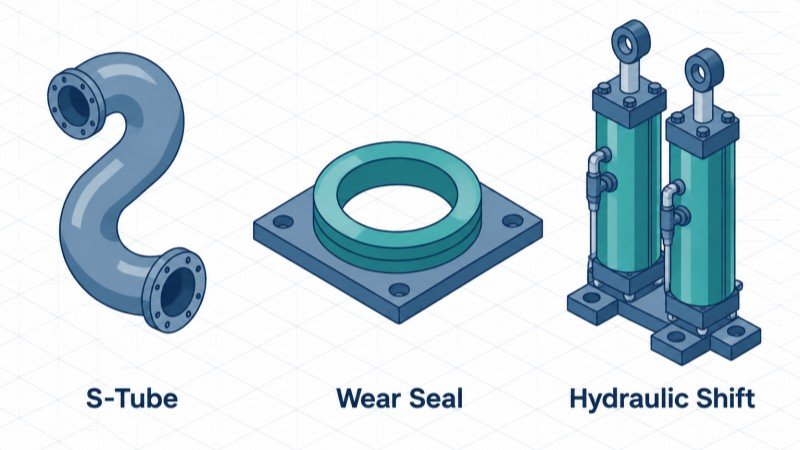
The whole assembly breaks down into three working groups: the tapered S-tube and outlet housing that carry the concrete, the wear plate and cutting ring that hold the pressure seal, and the external shift cylinders and slew bearing that power the swing.
Tapered S-Tube and Outlet Housing
The S-tube itself is a thick-walled manganese or alloy steel casting shaped in a smooth S-curve. That curve keeps friction and turbulence down as concrete transitions from the horizontal pumping cylinder into the rear outlet port.
To keep cylinders filling cleanly without choking the line, heavy-duty S-tubes taper gradually along their bore. On large-capacity pumps, the diameter commonly narrows from 230 mm (9 inches) at the cylinder intake down to 180 mm (7 inches) at the outlet housing. Those thick cast walls take a beating from coarse aggregate; while a skilled welder can often rebuild worn exterior surfaces or accessible inlet edges with hard-facing, once the internal bore wears thin below spec, the S-tube must be replaced to avoid high-pressure failure.
Wear Plate and Cutting Ring Sealing Pair
The wear plate (most mechanics call it the spectacle plate) bolts flush against the two concrete cylinder openings, while the cutting ring rides in the front mouth of the S-tube. Together, they create a sliding metal-to-metal seal that slices right through coarse stone on every shift and stops cement paste from bleeding back into the hopper.
Behind the cutting ring sits a heavy-duty rubber spring (or tensioning ring) and O-rings that keep it pressed tight against the wear plate. Once pumping pressure builds inside the S-tube, line pressure actually pushes the ring harder against the plate, making the seal tighter under load. Depending on your mix, a good cutting ring can easily push 20,000 cubic meters of concrete or more before it’s done—though sharp crushed granite or manufactured sand will chew through it much faster.
External Hydraulic Shift Cylinders and Slew Bearing
While the S-tube lives submerged in concrete, the two hydraulic shift cylinders, swing lever, and main support bearings stay completely outside the hopper. Keeping the drive gear out of the mud protects piston rods and seals from abrasive cement slurry and lets your mechanics inspect or swap components without tearing the hopper apart.
At the front of the hopper, the splined slew shaft and bearing take the side-to-side swinging loads, while at the rear, the outlet transition housing and large-end bearing support the S-tube outlet and absorb the heavy axial thrust generated under high pumping pressure.
S-Valve vs. Rock Valve and Ball Valve in Concrete Trailer Pumps
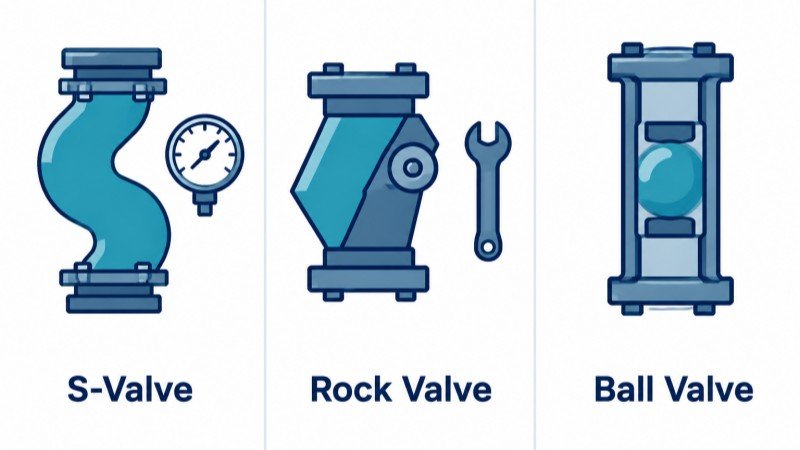
If you’re comparing trailer pump valve designs, an S-valve delivers strong high-pressure sealing and smooth, enclosed flow for long-distance pours—matching heavy-duty rock valves on pressure capability while offering hydraulic reverse pumping and far broader coarse-aggregate capacity than a ball-valve unit.
| Feature | S-Valve (S-Tube) | Rock Valve | Ball Valve |
| Sealing Mechanism | Wear plate + cutting ring (no kidney seal) | Wear plate + cutting ring + kidney seal | Gravity/pressure-seated steel balls |
| Pressure Suitability | 60–200+ bar (standard above 85 bar) | High to ultra-high pressure (comparable on heavy-duty units) | Low pressure |
| Reverse Pumping | Yes (hydraulic shift) | Yes (hydraulic shift) | No (flow-driven only) |
| Aggregate Range | Fine pea gravel up to 38–63 mm coarse aggregate | Broad coarse aggregate compatibility | Grout, mortar, and fine pea gravel only |
| Maintenance Trade-off | Tighter hopper access during washout and service | Easier external access for cleaning and part swaps | Frequent ball/seat wear; manual blockage clearing |
S-Valve vs. Rock Valve
Contractors mix these two up all the time and assume they’re just different names for the same valve. Both swing inside the hopper and both use a wear plate and cutting ring, but the sealing geometry is completely different and none of the spare parts are interchangeable.
An S-valve keeps concrete enclosed inside a single cast pipe exiting directly through the rear hopper wall via a concentric outlet seal, so there’s no sliding kidney seal to worry about. A rock valve uses a compact, enclosed pivoting housing that seals against the wear plate at the front and slides across a stationary kidney seal at the rear outlet to alternate both cylinders into a single line.
Out on a pour, the S-valve’s continuous, enclosed flow path minimizes mortar bypass at extreme pressures and moves tricky mixes like lightweight concrete without packing up. The catch is wrenching on it. Talk to any field mechanic and they’ll tell you rock valves are faster to wash out and service—changing wear parts on an S-valve usually means hunching down inside a cramped hopper cavity.
S-Valve vs. Ball Valve
First-time buyers—especially in shotcrete and small residential work—often grab a ball-valve trailer pump because the sticker price is lower and the rated output looks similar on paper.
The problem is how a ball valve works. It relies on steel balls inside vertical valve chambers that open and close strictly off concrete flow pressure. With no hydraulic drive behind the valve, a ball-valve pump can’t reverse to relieve line pressure. If a bad batch plugs your hose, you’re stuck cracking couplings and clearing the line manually—which is slow, messy, and genuinely dangerous. An S-valve pump lets you hit reverse right from the controls to drop pressure, and its wear parts last far longer when concrete mixes vary from load to load.
When Does a Project Require an S-Valve Concrete Trailer Pump?
Once delivery pressures climb past 85 bar (1,233 psi), pipelines stretch across long horizontal or vertical runs, or the spec calls for coarse, stiff, or steel-fiber mixes, an S-valve stops being an upgrade and becomes a requirement.

High-Pressure and Long-Distance Pumping Thresholds
You’ll still see S-valves on smaller machines—compact S-valve trailer pumps commonly run around 62 bar (900 psi) and mid-range units around 94 bar (1,363 psi) because crews want reverse pumping and coarse-aggregate capability even on everyday jobs. But 85 bar (1,233 psi) is the practical threshold where manufacturers treat the S-valve as the standard choice, scaling all the way up to 200 bar or more on heavy-duty stationary trailer pumps.
High-rise and long-line work shows what that setup can actually take:
- Burj Khalifa (Dubai): High-pressure S-valve trailer pumps fitted with reinforced S-tubes and heavy-duty bearings pushed concrete vertically to 606 meters. At peak height, the total concrete inside the delivery pipeline weighed over 26 metric tons, yet the units held an actual output of 28 m³/h at 200 bar concrete pressure during the peak stages of a 32-month pumping campaign.
- Long Fixed-Line Commercial Pours: On tight urban tower sites and long horizontal runs where crane access is limited, contractors rely on high-pressure S-valve trailer pumps to run repeated weekly pours through fixed pipelines without valve-related downtime.
Concrete Mix Compatibility and Aggregate Limits
S-valve pumps take a wide range of mixes in stride, from 10 mm pea gravel up to 38 mm structural coarse aggregate—and up to 63 mm rounded aggregate in specialized extra-large-bore units fitted with 200 mm (8-inch) or larger outlets and pipelines (since the delivery line inner diameter must typically be at least 3 times the maximum rounded gravel size, or 4 times for crushed stone). That positive shearing action at the cutting ring also handles low-slump shotcrete and steel-fiber reinforced concrete reliably.
That said, an S-valve isn’t the right tool for every pour. If you’re pumping very thin lean concrete, self-leveling floor screed, or tiny volumes where leftover hopper concrete and washout water disposal cost real money, a rotor (peristaltic) pump usually makes more sense. Rotor pumps empty the line almost completely and clean out in a fraction of the time.
4 Field Maintenance Practices to Extend S-Valve Service Life
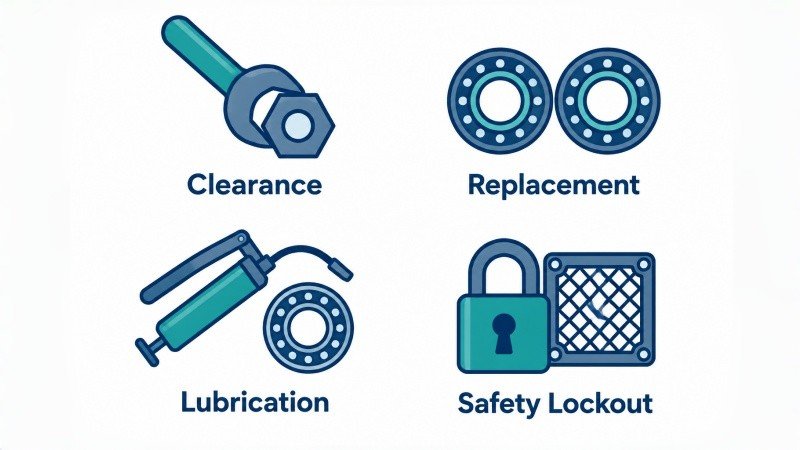
Getting full life out of an S-valve comes down to four habits: setting cutting-ring clearance under real concrete load, replacing worn wear plates instead of flipping them, staying on top of slew shaft bolt torque and bearing lubrication, and never cutting corners on hopper lockout.
Adjusting Cutting Ring Clearance Under Load
The gap between the cutting ring and wear plate makes or breaks your pumping efficiency. Leave it too loose and cement paste bleeds back into the hopper, causing instant pressure drops and dry-pack blockages. Crank the adjustment nut (located on the front slew shaft or rear outlet housing, depending on the pump design) too tight, though, and friction spikes against the wear plate.
It’s a classic shop-to-jobsite trap: a mechanic tightens the S-valve in the yard, cycles it dry, and everything shifts smoothly. Then the first mixer backs up, the hopper fills with concrete, and the valve stalls mid-shift.
Seasoned operators keep a wrench on hand for the first pour after any adjustment. If the valve binds once concrete fills the hopper, stop pumping, shut down the engine, and bleed hydraulic pressure before backing the locknut off 1/4 to 1/2 turn—then restart to confirm the valve shifts freely under load. To keep the assembly from binding up again later, always flush and clean the large O-ring inside the rear transition housing after every pour so hardened paste can’t wedge the seal tight.
Replacing Wear Plates Instead of Flipping Worn Surfaces
Single-sided wear plates—typically fitted with tungsten-carbide wear pads on one face—should never be flipped. Even with reversible wear plates that feature countersunk bolt holes on both faces, never flip a plate once the active face is deeply grooved or warped.
Bolting a grooved, worn face back against the delivery cylinder openings stops the cylinder intermediate rings and O-rings from sealing flat. On every high-pressure discharge stroke, water and cement paste bleed out through that gap back into the hopper—stripping the mix so concrete immediately dry-packs and chokes at the cylinder outlet, tanking output and rapidly eroding the cylinder ends and hopper wall. Swap the wear plate and cutting ring together as a matched set, and build wear-part costs into your per-cubic-meter operating budget from day one.
Monitoring Slew Shaft Bolt Torque and Bearing Lubrication
Put swing lever clamping bolt and slew shaft locknut torque checks on your regular service schedule. Under constant cyclic shock loads, loose shaft fasteners let the S-valve start hammering on the splined slew shaft, wallowing out the mounting bore and ruining an expensive shaft assembly.
Pair those torque checks with continuous automatic lubrication during pumping (or manual greasing every few hours and immediately after every washout) to maintain positive grease pressure at the slew and rear outlet seals, and flush the seal housings thoroughly so abrasive grit never works its way into the bearing races.
Following Hopper Safety Standards During Inspection
The hopper and S-valve zone will crush or shear a limb in a split second if the hydraulics cycle unexpectedly. In Europe, EN 12001 requires hopper protection grates to be either fixed (removable only with tools) or hinged with safety interlock switches, along with Stop Category 0 emergency stops and full hydraulic and pipeline pressure relief before anyone accesses the valve. Modern S-valve trailer pumps commonly use hinged grates fitted with RFID safety interlock switches that automatically halt pumping, agitation, and valve shifting the moment the grate lifts.
In North America, ASME B30.27 lays out strict inspection, maintenance, and operating safety responsibilities for owners, operators, and contractors. Before you ever reach into the hopper to inspect or adjust an S-valve, shut the engine completely off, bleed the hydraulic accumulator down to zero, and verify there is zero pressure left in the delivery line.
Choosing the Right S-Valve Setup for Your Jobsite
Picking a concrete trailer pump based on upfront price alone is an easy way to buy the wrong machine. Start with your peak required concrete pressure, total pipeline length, and maximum aggregate size—those three numbers tell you straight away whether an S-valve is worth the investment.
Once the machine is on site, keeping your cost per cubic meter down comes down to simple discipline: fine-tune ring clearance under load, replace wear plates and cutting rings as matched sets, keep the slew shaft tight and greased, and treat hopper lockout as non-negotiable.
If you’re sizing concrete trailer pumps for an upcoming high-rise, infrastructure, or commercial pour and want straightforward engineering input on pressure ratings or S-valve configurations, Contact us to talk through your project specs with our team.