-
Whatsapp: +86 15938761000
-
Email: likang@shconcretemixer.com
-
Address: Shenglong Youyi City, Zhongyuan District, Zhengzhou City, Henan Province
-
Whatsapp: +86 15938761000
-
Email: likang@shconcretemixer.com
-
Address: Shenglong Youyi City, Zhongyuan District, Zhengzhou City, Henan Province
How to Choose a Suitable Concrete Batching Plant: A Complete Buyer Guide
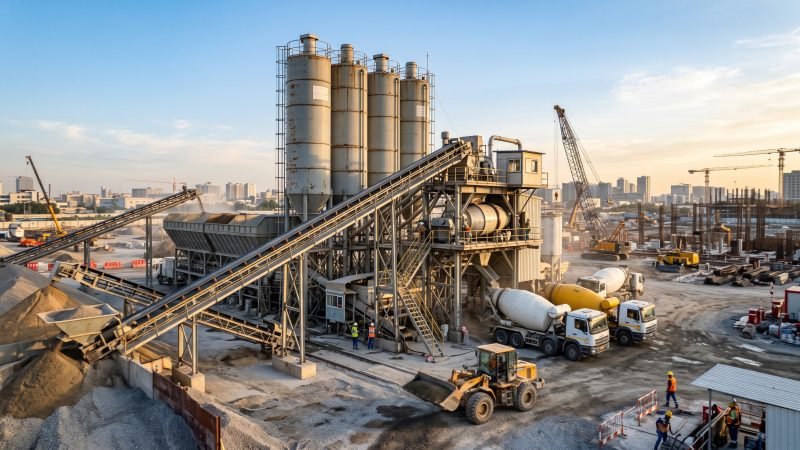
What are the essential factors you must evaluate to select the perfect concrete batching plant for your construction project?
To choose a suitable concrete batching plant, you must evaluate your preferred mixing method (wet versus dry), determine the necessary plant mobility based on your project lifecycle, accurately size your production capacity for peak pour requirements, select appropriate core mixers and automation controls, and calculate the comprehensive total cost of ownership including auxiliary equipment and site utilities.
Determining Your Mixing Method: Wet Batch vs. Dry Batch
What is the fundamental difference between a wet batch and a dry batch concrete plant?
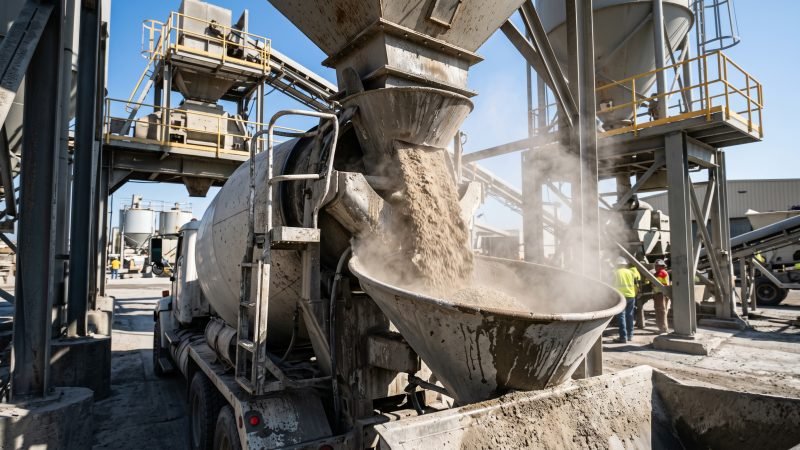
A wet batch plant mixes all ingredients, including water, in a central mixer before discharging the wet concrete. Conversely, a dry batch concrete plant only weighs the dry materials. It drops them directly into a transit mixer truck, which adds water and mixes everything during transport.
Concrete Quality and Slump Consistency Requirements
How strict are the engineering specifications for your project? A wet batch plant utilizes a heavy-duty central mixer. This machine aggressively blends the cement, aggregates, and water. Therefore, it produces a completely uniform mixture. You get precise control over the water-to-cement ratio and the concrete slump.
In contrast, a dry batch plant relies on the transit truck’s rotating drum to mix the concrete. This method is less efficient. It can sometimes leave unmixed dry pockets near the bottom of the drum.
Think of this like preparing aggregate sub-bases for road construction. Using a dedicated pugmill mixer blends the gravel and binding agents perfectly. Simply tossing the materials together with an excavator bucket leaves uneven patches. Similarly, a central concrete mixer guarantees a superior, uniform blend.
Wet batch plants generally achieve a completely homogeneous mix in 30 to 90 seconds, making them ideal for high-specification projects. Please verify these specific cycle time parameters with your plant supplier to ensure they meet your production goals.
| Feature | Wet Batch Plant | Dry Batch Plant |
|---|---|---|
| Mixing Location | Inside a central plant mixer | Inside the transit truck drum |
| Slump Control | Highly accurate and consistent | Variable, depends on the truck driver |
| Concrete Quality | Excellent homogeneity | Good, but prone to dry pockets |
| Best For | Structural concrete, precast, paving | General construction, rural projects |
Project Delivery Radius and Transit Mixer Availability
Where is your actual job site located? Wet concrete begins the chemical hydration process immediately. As a result, you face a strict time limit. Trucks typically must pour wet concrete within 90 minutes. If traffic delays the truck, the concrete can harden inside the drum.
Dry batching easily solves this distance limitation. The plant loads dry materials into the truck. The driver then waits to add water until they are closer to the job site. Consequently, you can safely transport materials over much longer distances.
However, your transport fleet matters heavily. Dry batch plants absolutely require a fleet of expensive transit mixer trucks. The trucks perform all the mixing work. Wet batch plants offer slightly more transport flexibility. For very short distances, such as highway paving right next to the plant, you can even transport wet concrete using standard dump trucks.
Initial Capital Investment and Maintenance Differences
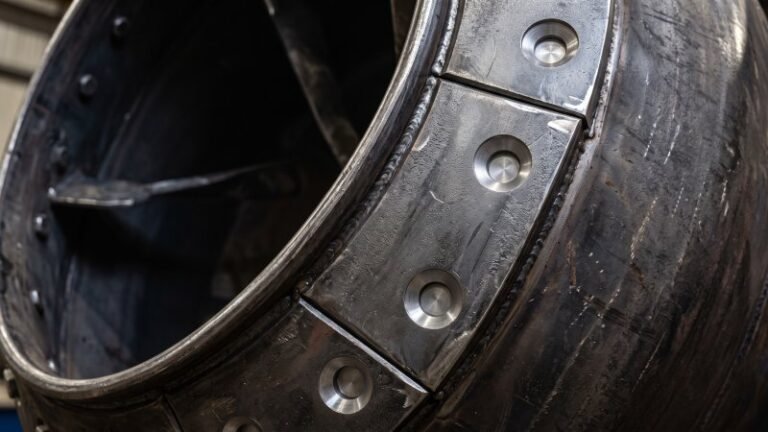
Wet plants require a significantly larger upfront investment. You must purchase the massive central mixer unit. Furthermore, this central mixer demands continuous, rigorous maintenance. The mixing process is highly abrasive. You will need to regularly replace steel wear liners and mixing blades.
Dry batch plants cost much less to purchase initially. They simply drop weighed materials down a chute. They do not have a central mixer to power or maintain. Therefore, the plant itself experiences very little physical wear and tear.
Does this mean dry batching is always cheaper to maintain? Not exactly. A dry plant simply shifts the wear and tear onto your transit trucks. Because the truck drums do all the heavy mixing, their internal steel fins wear out much faster. You will spend more money maintaining your truck fleet over time.
Selecting the Right Plant Mobility for Your Project Lifecycle
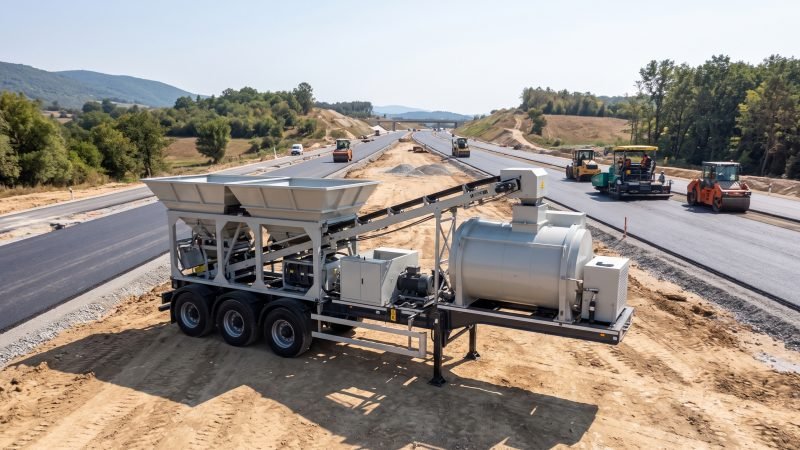
Selecting the right plant mobility depends entirely on your project duration and geographical layout. Stationary plants are built for multi-year operations at a single, permanent location. Conversely, mobile plants feature wheeled chassis designs for rapid relocation, making them ideal for temporary or linear projects where the production site must move alongside the active construction zone.
Stationary Plants for Long-Term Commercial Production
Stationary batching plants are permanent installations. Manufacturers design them for long-term use in a single location. Therefore, commercial ready-mix concrete suppliers almost exclusively choose stationary plants. These businesses need a reliable, permanent base to serve a wide local radius for a decade or longer.
Large-scale, centralized mega-projects also require stationary plants. For example, constructing a massive hydroelectric dam demands continuous concrete production in one exact spot for several years.
Think of a stationary plant like a tower crane on a high-rise project. It requires significant time and heavy lifting to erect initially. However, once installed, it provides unmatched stability and serves a massive, centralized work area efficiently.
Because they do not need to fit on standard road trailers, stationary plants utilize heavy, spacious structural steel frames. This open structural layout gives operators plenty of safe walkways. Consequently, daily maintenance and parts replacement become much easier and safer for your crew.
Mobile and Compact Plants for Fast-Track Linear Projects
Not every construction project stays in one place. Linear infrastructure projects, such as highway expansions or railway networks, stretch across many miles. For these jobs, transporting wet concrete from a single stationary plant eventually becomes impossible.
Mobile concrete plants solve this logistical problem. Engineers mount the main plant components directly onto a wheeled chassis. You simply attach a heavy-duty tractor unit and tow the plant to the next job site. Compact plants offer a similar logistical benefit. They use modular frames designed to fit perfectly inside standard shipping containers for rapid transport.
Think of a mobile plant like a crawler crane. It trades some structural permanence for the critical ability to reposition quickly as the job site footprint evolves.
Mobile plants drastically reduce installation time. Erection times typically range from three to seven days. However, because axle towing weight limits vary significantly based on local highway regulations, verify these exact transport parameters with your supplier before planning your route.
| Feature | Stationary Plant | Mobile Plant |
|---|---|---|
| Design Focus | Permanence and maximum stability | Portability and rapid deployment |
| Relocation Frequency | Never (or very rarely) | Every few months or years |
| Ideal Project Type | Commercial ready-mix, dams | Highways, railways, canals |
| Maintenance Access | Highly spacious and accessible | Tighter, compact component spaces |
Foundation and Civil Work Constraints on Site
Mobility is not just about moving the steel equipment. It heavily involves the ground underneath the plant. Site foundation requirements often dictate which plant you can actually install.
Stationary plants carry massive structural weight and height. Consequently, they require extensive civil engineering work. You must excavate the site and pour deep, reinforced concrete foundations. This process is incredibly time-consuming. Structural concrete generally requires 28 days to cure and reach full strength. Therefore, pouring a deep foundation delays your actual plant installation by nearly a month.
Furthermore, if your site has soft or sandy soil, you might need to drive structural piles deep into the ground. This adds massive civil engineering costs to your initial project budget.
Mobile and compact plants eliminate most of this heavy civil work. They distribute their operational weight across a wider, integrated steel chassis. Because of this footprint, mobile plants generally require zero deep excavations. You only need a flat, well-compacted soil surface or a simple temporary concrete slab.
Bypassing deep foundations saves enormous amounts of time and money. When your project finishes, you simply tow the mobile plant away. You do not have to spend money demolishing a massive concrete foundation, allowing you to restore the natural site quickly.
Sizing Your Plant Capacity and Aggregate Handling System
How do you accurately determine the right production capacity and aggregate feeding system for your concrete batching plant?
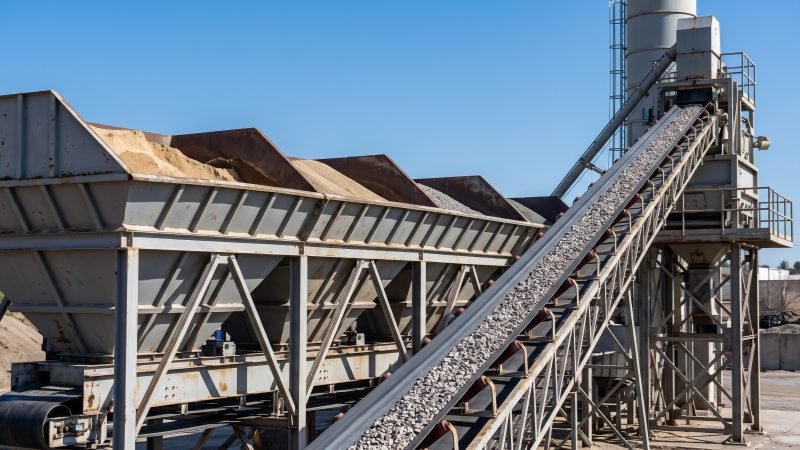
You must calculate your highest hourly peak pour requirement rather than your daily average. This ensures the plant handles maximum demand without costly delays. Furthermore, you must match your available site space with the correct aggregate feeding method. You can choose either a compact skip hoist or a high-capacity continuous belt conveyor, while ensuring your storage bins support continuous production.
Calculating Peak Pour Requirements vs. Continuous Output
Many buyers make the mistake of sizing a plant based on daily total volume. However, concrete construction rarely happens at a steady, flat rate. You must focus on your peak pour requirements.
For instance, a foundation project might need 300 cubic meters of concrete in a single day. You might assume a small 40 cubic meter per hour (m³/h) plant running for eight hours is sufficient. However, what if that structural foundation requires a continuous, rapid pour within a strict four-hour window? In that scenario, your small plant will fail to meet the tight deadline. You would actually need a plant capable of delivering at least 75 m³/h.
Think of this like sizing a hydraulic pump for a heavy lifting cylinder on an excavator. You do not size the hydraulic pump for the total volume of oil moved in a day. Instead, you size it to handle the maximum pressure flow rate needed during the heaviest single lift.
Always look at your most demanding construction phase. Size your plant to comfortably exceed that specific hourly peak.
Additionally, you must distinguish between theoretical capacity and actual output. A plant rated for 100 m³/h rarely produces that exact amount continuously. Real-world output drops due to truck positioning delays and material loading times. Actual production is typically 80% to 85% of the theoretical maximum. Always account for this efficiency loss when calculating your realistic output goals.
Belt Conveyor vs. Skip Hoist: Matching Plant Footprint to Site Space
Once you determine the capacity, you must decide how to lift heavy aggregates into the mixer. The two standard options are belt conveyors and skip hoists. Your physical site footprint directly controls this decision.
A skip hoist uses a steel bucket pulled up a steep rail system by a motorized steel cable. Because the rails operate at a very steep angle, this setup requires very little ground space. Consequently, skip hoists are perfect for tight urban construction lots. However, they operate in batches. The bucket must travel up, dump, and travel back down. This slower cycle limits maximum production.
In contrast, a belt conveyor uses a long, continuous rubber belt to transport sand and gravel. Conveyors move materials smoothly and rapidly. Therefore, they easily support high-capacity plants producing over 90 m³/h. The major drawback is the required footprint. Conveyors generally operate at a 15 to 20-degree incline. As a result, they require a very long strip of land to reach the top of the mixer.
| Feature | Skip Hoist System | Belt Conveyor System |
|---|---|---|
| Site Footprint | Very compact; requires minimal space | Very large; requires a long linear footprint |
| Operation Type | Batch transfer (up and down cycles) | Continuous flow transfer |
| Production Capacity | Best for low to medium output (< 90 m³/h) | Best for high output (> 90 m³/h) |
| Maintenance Need | High wear on steel cables and guide rails | Routine greasing and periodic belt tensioning |
Aggregate Storage Bin Sizing and Batching Accuracy Needs
Aggregate batchers, or storage bins, hold your different types of sand and crushed stone. Properly sizing these bins is critical for uninterrupted production.
The required bin size depends heavily on your local material supply chain. If your gravel supplier is nearby and their dump trucks can deliver materials continuously, you can use smaller storage bins. Conversely, if your quarry is far away, you need much larger bins. Large bins act as a secure buffer. They keep your plant running even if a delivery truck gets stuck in traffic.
Beyond volume, batching accuracy is absolutely essential. Modern aggregate bins sit on top of sensitive electronic load cells. These sensors weigh the sand and stone before dropping them onto the conveyor or into the hoist.
Accurate batching directly impacts both concrete strength and your profit margins. Adding too much expensive cement or aggregates ruins your project budget quickly.
Because raw materials like wet sand often stick to the sides of bins, engineers install pneumatic vibrators on the bin walls. These vibrators shake the materials loose, ensuring precise weights drop every single time.
Evaluating Core Mixers and Control Automation Levels
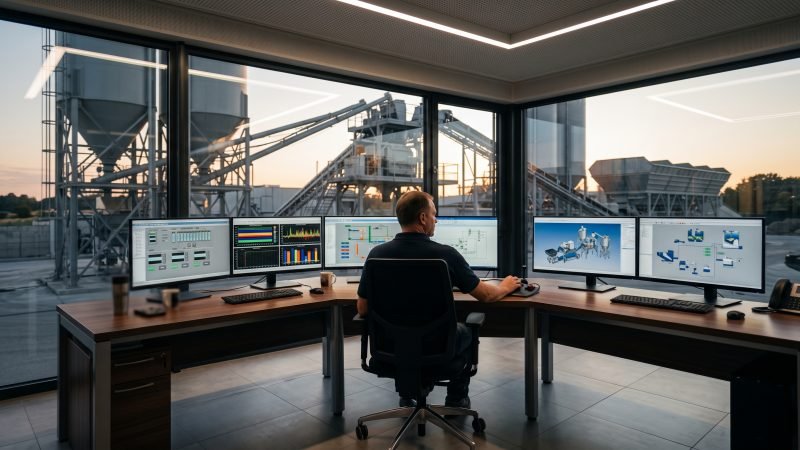
Guaranteeing consistent concrete quality requires matching the correct core mixer design to your recipe and implementing a highly reliable control system. Deploying the right twin-shaft or planetary mixer ensures thorough blending, while a fully automated PLC system guarantees batching accuracy and robust dust collection keeps your operation compliant with environmental permits.
Twin-Shaft vs. Planetary Mixers for Specific Concrete Applications
Your central mixer is the beating heart of your entire operation. Therefore, you must select the right design for your specific product. The two most popular industrial choices are twin-shaft and planetary mixers.
Twin-shaft mixers utilize two horizontal shafts equipped with heavy-duty paddles. These paddles counter-rotate to create a highly aggressive, three-dimensional mixing action. Consequently, they process high volumes of standard ready-mix concrete incredibly fast. They also handle very large aggregate stones effortlessly.
In contrast, planetary mixers operate on a vertical axis. The mixing stars rotate on their own axes while simultaneously sweeping around the central pan. This complex motion provides intense shearing action. Therefore, planetary mixers are perfect for producing stiff, low-slump concrete used in precast pipes, blocks, and architectural panels.
Think of a planetary mixer like a specialized slip-form paver meticulously laying down a precise, high-density concrete barrier. Meanwhile, a twin-shaft mixer acts more like a massive primary jaw crusher rapidly processing huge volumes of raw material. Both are powerful, but they serve distinct purposes.
When evaluating these options, always check the maximum allowable aggregate dimension limits for your specific mixer model. Twin-shaft mixers generally accept much larger stones than planetary models, which is crucial to know to avoid internal jamming.
| Mixer Feature | Twin-Shaft Mixer | Planetary Mixer |
|---|---|---|
| Mixing Shaft Orientation | Horizontal | Vertical |
| Mixing Action | Aggressive lifting and folding | Intense shearing and sweeping |
| Ideal Concrete Slump | Medium to high slump | Zero to low slump |
| Best Application | Commercial ready-mix, dams | Precast products, pavers, blocks |
Fully Automated PLC Systems vs. Semi-Automated Controls
Once you choose a mixer, you must decide how to operate the plant. Control systems generally fall into two categories: semi-automated and fully automated setups.
Semi-automated systems rely heavily on manual operator input. The operator must physically push buttons to weigh materials, discharge bins, and add water. While cheaper initially, this method introduces significant human error. Operator fatigue leads to inconsistent concrete slump and wasted expensive cement.
Fully automated PLC (Programmable Logic Controller) systems remove this human error. You simply input the concrete recipe into the computer software. The PLC takes over completely. It automatically controls load cells, opens pneumatic gates, and monitors the exact mixing time.
Furthermore, advanced PLC systems integrate seamlessly with microwave moisture probes inside the sand bins. If your sand is unusually wet after a rainstorm, the PLC detects this excess moisture. It then automatically reduces the added water amount to maintain the perfect water-to-cement ratio.
Dust Collection and Environmental Permitting Compliance
Concrete production generates massive amounts of airborne cement dust. If you do not control this dust, environmental agencies will quickly revoke your operational permits. Therefore, robust dust collection is completely mandatory.
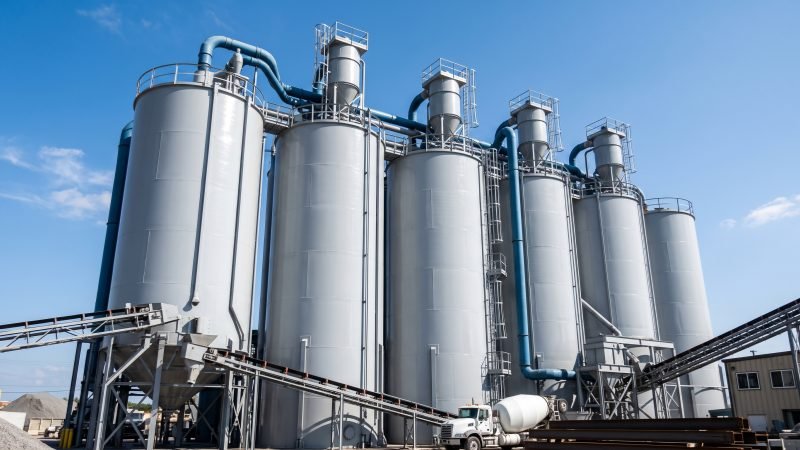
The primary dust emission points are the cement silos and the central mixer itself. To combat this, plants utilize pneumatic baghouse filters. Engineers install these filter units directly on top of the silos. When pneumatic trucks pump dry cement into the silo, displaced dusty air rushes upward. The filter bags trap the cement particles. This allows only clean air to escape into the atmosphere.
Subsequently, reverse air pulse jets automatically blast compressed air through the internal filters. This action shakes the trapped cement dust back down into the silo. Consequently, you save valuable raw materials and keep the filters breathing freely. Make sure your specific baghouse filter surface area is rated to meet your local environmental emission limits to ensure full legal compliance.
Calculating Total Ownership Cost Beyond the Purchase Price
How do you accurately calculate the true long-term financial impact of a concrete batching plant before signing the purchase agreement?
You must look far beyond the initial base price of the plant itself. A complete cost calculation includes the essential auxiliary equipment, site-specific electrical and water utility infrastructure, and the plant’s long-term structural durability, which ultimately dictates its final resale value.
Auxiliary Equipment Requirements: Silos, Weighing, and Admixture Systems
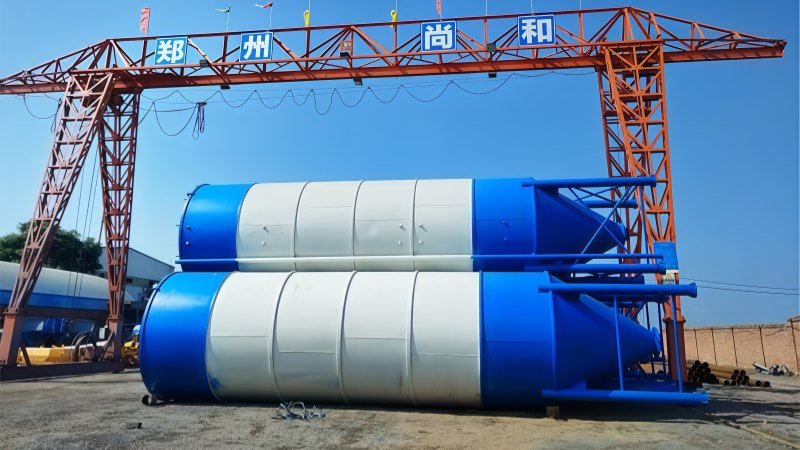
Buyers often focus purely on the main mixer and aggregate bins. However, auxiliary equipment adds significantly to your final equipment bill. You absolutely must purchase massive cement silos to store dry bulk cement and fly ash safely. A standard commercial project typically requires silos holding between 50 and 200 tons of material. Silo structural wind load ratings must be verified for your specific region to guarantee site safety.
Furthermore, you must invest in highly accurate weighing scales and liquid admixture systems. Chemical admixtures drastically change how the concrete cures and flows. Therefore, they require precision pneumatic dosing pumps to avoid ruining a batch.
Think of this entire plant setup like outfitting a bare heavy-duty bulldozer. You might buy the base machine, but you still must purchase the specific ripper attachments and heavy grading blades separately to actually perform the earthmoving work.
Power Requirements and Utility Access on Site
Concrete batching plants consume massive amounts of electrical power and clean water. If your job site sits in a remote area, pulling a dedicated high-voltage line from the local electrical grid becomes incredibly expensive. Consequently, you will likely need to purchase or lease large industrial diesel generators.
Starting a fully loaded central mixer requires a massive surge of electrical current. For example, the heavy-duty electric motors on a large central mixer can easily draw over 110 kilowatts combined. This electrical draw is very similar to the massive startup power needed to run a heavy jaw crusher in a rock quarry.
Additionally, you must secure a high-volume, reliable water source. You need hundreds of gallons of water daily for the concrete mix itself and for cleaning the mixer. Furthermore, extreme weather introduces hidden costs. If you operate in freezing winter conditions, you must buy powerful water heating systems. Conversely, in very hot climates, you must install expensive water chillers to prevent the concrete from cracking.
Resale Value and Equipment Durability Factors
The true total cost of ownership equals your initial purchase price minus the final resale value. Buying the absolute cheapest plant available almost always costs you more money in the long run.
Cheaply built plants use thinner, lower-grade structural steel. Therefore, they rust rapidly and suffer structural fatigue from the daily aggressive vibration of the mixing process. When your construction project finishes, nobody wants to buy a rusted, compromised machine.
In contrast, high-quality plants utilize thicker, wear-resistant steel alloys and durable polyurethane paint coatings. Consequently, they hold their market value exceptionally well. A premium, properly maintained batching plant easily commands a strong price on the secondary heavy machinery market.
Remember, spending slightly more upfront for thicker steel guarantees a much higher return when you eventually sell the equipment.
Conclusion
Choosing the right concrete batching plant is a critical decision that impacts your project’s efficiency, budget, and long-term profitability. By carefully evaluating whether you need a wet or dry system, selecting the correct mobility for your site, accurately calculating capacity, and understanding the total cost of a concrete batching plant, you can ensure a successful and profitable operation. If you need a detailed technical consultation to protect your project budget, please contact us to review your specific operational numbers and equipment needs.