-
Whatsapp: +86 15938761000
-
Email: likang@shconcretemixer.com
-
Address: Shenglong Youyi City, Zhongyuan District, Zhengzhou City, Henan Province
-
Whatsapp: +86 15938761000
-
Email: likang@shconcretemixer.com
-
Address: Shenglong Youyi City, Zhongyuan District, Zhengzhou City, Henan Province
How to Choose a Suitable Concrete Batching Plant: A Complete Buyer Guide
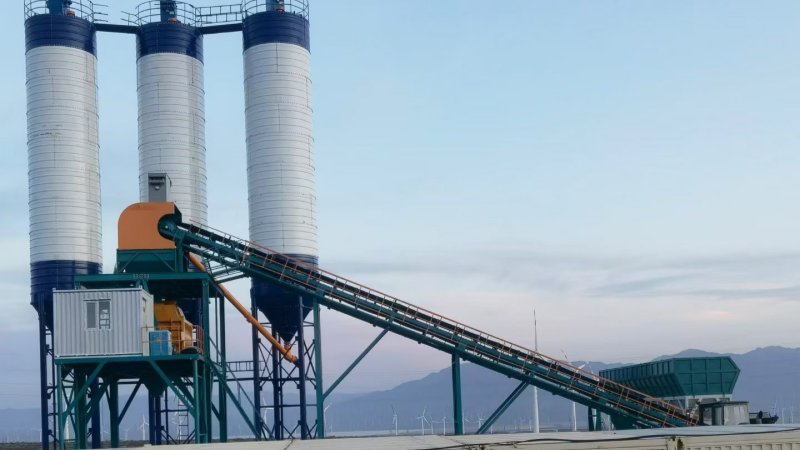
Selecting the right concrete batching plant requires a thorough evaluation of your project’s specific needs. You need to weigh your mixing method (wet versus dry), determine the required mobility based on your project timeline, accurately size your production capacity for peak pours, choose the right core mixers and automation, and calculate the true total cost of ownership including site utilities and auxiliary equipment.
Determining Your Mixing Method: Wet Batch vs. Dry Batch
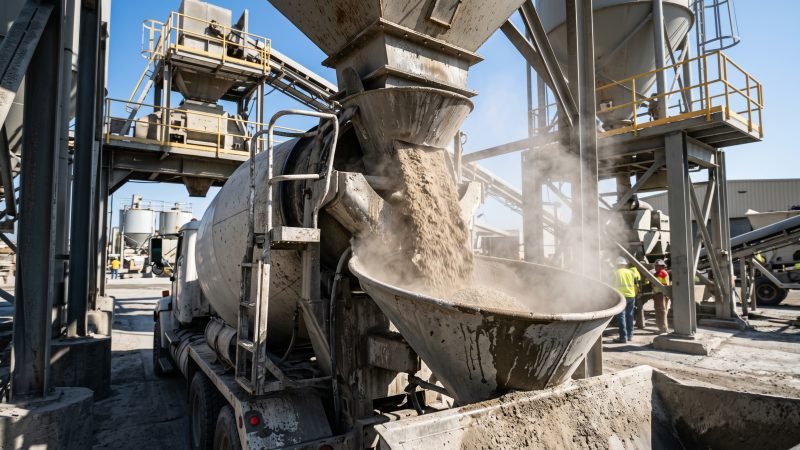
A wet batch plant mixes all ingredients, including water, in a central mixer before discharging the uniform wet concrete into a truck. A dry batch plant, on the other hand, weighs the dry materials and drops them into a transit mixer truck. The water is also precisely measured by the plant and piped directly into the truck’s drum (or onboard water tank), where the actual mixing happens during transport.
Concrete Quality and Slump Consistency Requirements
For projects with strict engineering specifications, a wet batch plant is usually the standard. Its heavy-duty central mixer aggressively blends cement, aggregates, and water, producing a completely uniform mixture in 30 to 90 seconds. This gives operators precise control over the water-to-cement ratio and the concrete slump.
With a dry batch plant, the mixing relies entirely on the transit truck’s rotating drum. While highly effective for general construction, this method is less efficient and can sometimes leave unmixed dry pockets. Crucially, the quality of dry-batched concrete depends heavily on the condition of the truck drum’s internal steel fins. Worn-out fins will lead to poor mixing and aggregate segregation, whereas well-maintained trucks can still deliver a highly consistent product.
| Feature | Wet Batch Plant | Dry Batch Plant |
|---|---|---|
| Mixing Location | Inside a central plant mixer | Inside the transit truck drum |
| Slump Control | Highly accurate and consistent | Variable, depends on the truck driver |
| Concrete Quality | Excellent homogeneity | Good, suited for standard commercial specs |
| Best For | Structural concrete, precast, paving | General construction, rural projects, long distances |
Project Delivery Radius and Transit Mixer Availability
Location dictates your timeline. Wet concrete begins the chemical hydration process immediately, meaning trucks typically must pour it within 90 minutes. Traffic delays can harden the concrete inside the drum and ruin the batch.
Dry batching extends this delivery radius. Because the materials are mixed later in the transit cycle, you can safely transport materials over much longer distances. However, this method requires a reliable, well-maintained fleet of expensive transit mixer trucks to handle the heavy mixing work. Wet batch plants offer slightly more transport flexibility for ultra-short distances—such as highway paving immediately adjacent to the plant—where even standard dump trucks can be used to move the stiff mix.
Initial Capital Investment and Maintenance Differences
Wet plants demand a larger upfront investment due to the massive central mixer, which also requires continuous, rigorous maintenance. The highly abrasive mixing process means you will regularly replace steel wear liners and mixing blades.
Dry batch plants cost less initially and require less plant-side maintenance since they lack a central mixer. However, they simply shift the wear and tear onto your transit trucks. The heavy, dry-to-wet mixing action accelerates the wear on the drum’s internal fins, meaning you will spend more money maintaining your truck fleet over time.
Selecting the Right Plant Mobility for Your Project Lifecycle
The choice between stationary and mobile configurations depends entirely on your project duration and geographical site layout.
Stationary Plants for Long-Term Commercial Production
Built for permanence, stationary batching plants are the go-to choice for commercial ready-mix suppliers and massive centralized mega-projects, like hydroelectric dams. Once erected, they provide unmatched stability and continuous high-volume output for years.
Because they don’t need to fit standard road trailer dimensions, stationary plants utilize heavy, spacious structural steel frames. This open layout provides excellent, safe access for operators, making daily maintenance and parts replacement much easier.
Mobile and Compact Plants for Fast-Track Linear Projects
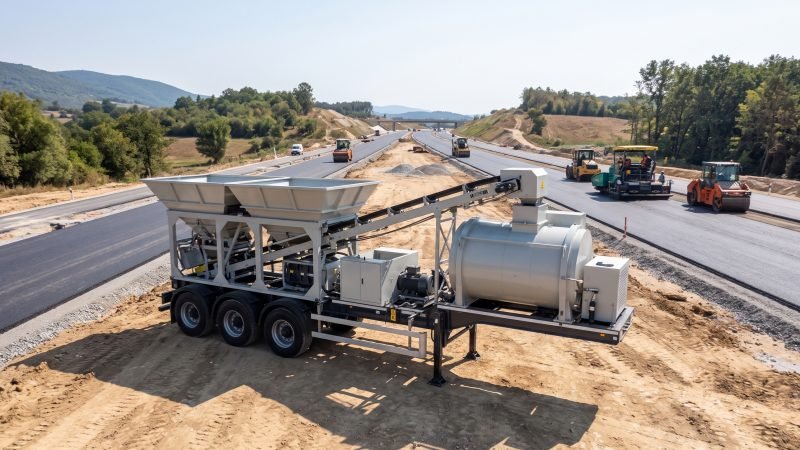
For linear infrastructure projects like highway expansions or railway networks, transporting wet concrete from a single permanent base isn’t viable. Mobile plants solve this logistical problem by mounting the main components onto wheeled chassis for rapid relocation. Compact plants offer a similar logistical edge, utilizing modular frames designed to fit inside standard shipping containers for fast deployment.
Think of a mobile plant like a crawler crane—it trades some structural permanence for the critical ability to reposition quickly as the job site evolves. Erection times typically drop to just a few days.
| Feature | Stationary Plant | Mobile Plant |
|---|---|---|
| Design Focus | Permanence and maximum stability | Portability and rapid deployment |
| Relocation Frequency | Never (or very rarely) | Every few months or years |
| Ideal Project Type | Commercial ready-mix, dams | Highways, railways, canals |
| Maintenance Access | Highly spacious and accessible | Tighter, compact component spaces |
Foundation and Civil Work Constraints on Site
Ground conditions heavily dictate plant selection. Stationary plants carry immense structural weight and require deep, reinforced concrete foundations. Pouring and curing these foundations can delay equipment installation by nearly a month. If the site has soft soil, expensive structural piling may also be required.
Mobile and compact plants bypass most of this heavy civil work. Their integrated chassis distributes the operational weight over a wider area, usually requiring only a well-compacted soil surface or a basic temporary concrete slab. This saves substantial time and money, both during setup and post-project site restoration.
Sizing Your Plant Capacity and Aggregate Handling System
Accurately sizing your plant means looking at peak demand rather than daily averages, and matching the material feeding system to your available space.
Calculating Peak Pour Requirements vs. Continuous Output
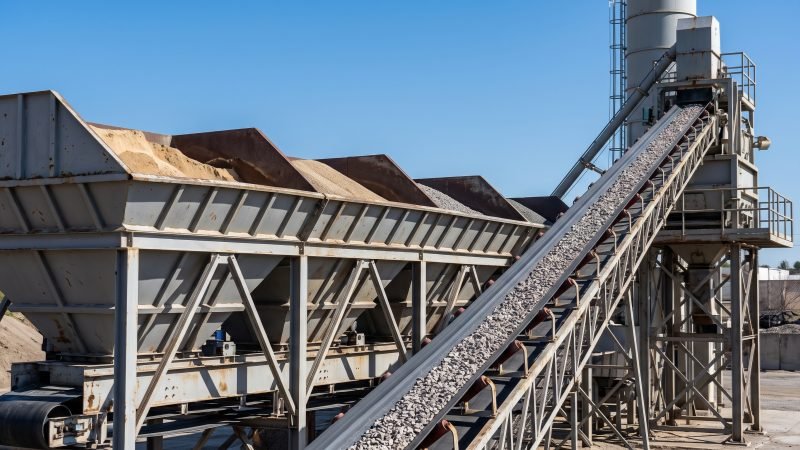
Sizing a plant based on daily total volume is a common trap. Concrete construction happens in bursts. If a structural foundation requires a rapid, continuous pour of 300 cubic meters within a tight four-hour window, a small 40 m³/h plant will bottleneck your operation. You must size your plant to comfortably exceed your most demanding hourly peak.
Additionally, theoretical capacity rarely equals actual output. Real-world production is typically 80% to 85% of the maximum rating due to material loading times and truck turn-around time. If your transit mixer fleet cannot cycle fast enough to catch and transport the concrete, your plant’s high capacity is entirely wasted. Always factor in truck availability when calculating realistic output.
Belt Conveyor vs. Skip Hoist: Matching Plant Footprint to Site Space
Your physical site footprint dictates how aggregates are lifted into the mixer. Skip hoists use a steel bucket pulled up a steep rail system, requiring very little ground space—perfect for tight urban lots. However, the batch-style up-and-down cycle limits maximum production.
Belt conveyors use a continuous rubber belt to move materials smoothly and rapidly. They easily support high-capacity plants producing over 90 m³/h. The primary drawback is their footprint; operating at a 15 to 20-degree incline, conveyors require a long strip of land to reach the top of the mixer.
| Feature | Skip Hoist System | Belt Conveyor System |
|---|---|---|
| Site Footprint | Very compact; requires minimal space | Very large; requires a long linear footprint |
| Operation Type | Batch transfer (up and down cycles) | Continuous flow transfer |
| Production Capacity | Best for low to medium output (< 90 m³/h) | Best for high output (> 90 m³/h) |
| Maintenance Need | High wear on steel cables and guide rails | Routine greasing and periodic belt tensioning |
Aggregate Storage Bin Sizing and Batching Accuracy Needs
Storage bin capacity should reflect your local supply chain. If your quarry is far away or delivery times are unpredictable, you need larger bins to act as a secure buffer to keep the plant running.
Batching accuracy is non-negotiable. Modern aggregate bins utilize sensitive electronic load cells to weigh materials precisely. Adding too much expensive cement or aggregate quickly destroys project profit margins. Pneumatic vibrators installed on the bin walls ensure even sticky materials, like wet sand, drop cleanly and accurately every time.
Evaluating Core Mixers and Control Automation Levels
Consistent concrete quality relies on matching the right mixer design to your product and utilizing robust control systems.
Twin-Shaft vs. Planetary Mixers for Specific Concrete Applications
The central mixer is the core of a wet batch plant. Twin-shaft mixers feature a wide internal chamber with two horizontal, counter-rotating shafts equipped with heavy-duty paddles. This spacious design and aggressive, three-dimensional mixing action rapidly processes massive volumes of standard ready-mix concrete and handles larger aggregate stones with ease.
Planetary mixers operate on a vertical axis. The mixing stars sweep around the central pan while rotating on their own axes, providing intense shearing action. This makes planetary mixers ideal for producing the stiff, zero-slump concrete required for precast pipes, blocks, pavers, and architectural panels.
| Mixer Feature | Twin-Shaft Mixer | Planetary Mixer |
|---|---|---|
| Mixing Shaft Orientation | Horizontal | Vertical |
| Mixing Action | Aggressive lifting and folding | Intense shearing and sweeping |
| Ideal Concrete Slump | Medium to high slump | Zero to low slump |
| Best Application | Commercial ready-mix, dams | Precast products, pavers, blocks |
Fully Automated PLC Systems vs. Semi-Automated Controls
While semi-automated systems are cheaper initially, they rely on manual button-pushing, which introduces human error, operator fatigue, and inconsistent batching.
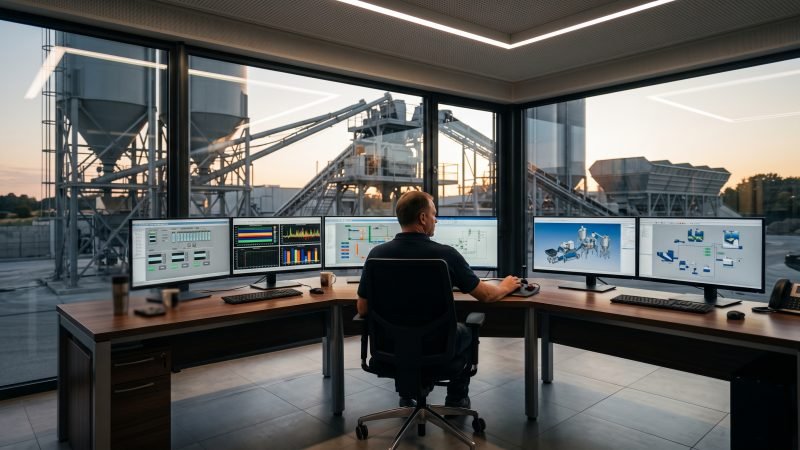
Fully automated PLC (Programmable Logic Controller) systems eliminate this risk. Once the recipe is inputted, the computer automatically controls load cells, opens gates, and monitors mixing times. Advanced PLCs even integrate with microwave moisture probes inside the sand bins. If the sand is unusually wet, the system detects the excess moisture and automatically reduces the added water to maintain the perfect water-to-cement ratio.
Dust Collection and Environmental Permitting Compliance
Concrete production generates significant airborne cement dust. To maintain operational permits and stay compliant with environmental agencies, robust dust collection is mandatory at the cement silos and the central mixer.
Plants utilize pneumatic baghouse filters mounted directly on top of the silos. When dry cement is pumped in, the filter bags trap the dust particles while letting clean air escape. Reverse air pulse jets then automatically blast compressed air through the filters, shaking the trapped cement back down into the silo. This self-cleaning action keeps the filters breathing and saves valuable raw material.
Calculating Total Ownership Cost Beyond the Purchase Price
The true financial impact of a batching plant extends far beyond its initial sticker price. A complete calculation includes auxiliary equipment, site utilities, and equipment durability.
Auxiliary Equipment Requirements: Silos, Weighing, and Admixture Systems
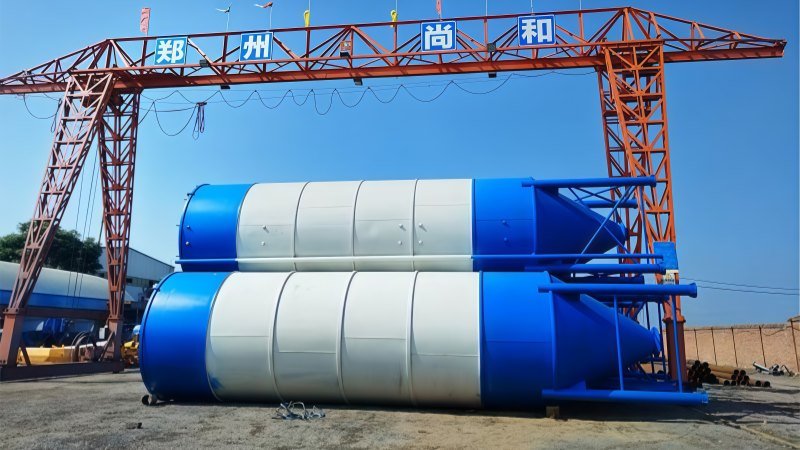
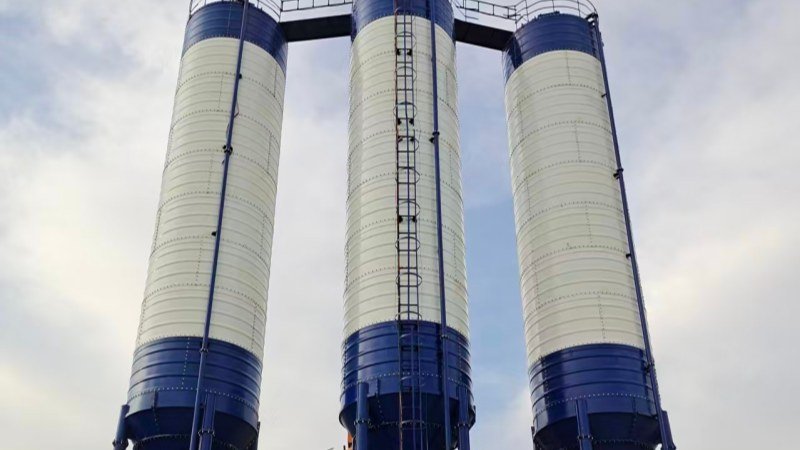
The main mixer and aggregate bins are only part of the equipment bill. You must account for massive cement silos—typically holding 50 to 200 tons—which must be structurally rated for your specific region’s wind loads.
Additionally, you need highly accurate liquid admixture systems. Chemical admixtures dictate how the concrete cures and flows. Because they are highly potent, they require precision pneumatic dosing pumps to avoid completely ruining a batch.
Power Requirements and Utility Access on Site
Batching plants draw heavy electrical loads. Starting a fully loaded central mixer requires a massive surge of current, with main motors often drawing over 110 kilowatts combined. If high-voltage grid power is unavailable, you will need to purchase or lease large industrial diesel generators.
A high-volume, reliable water source is also mandatory for the mix itself and daily equipment cleanout. Extreme climates introduce hidden utility costs: freezing conditions require powerful water heating systems, while hot climates demand expensive water chillers to prevent the concrete from curing prematurely.
Resale Value and Equipment Durability Factors
The total cost of ownership equals your initial purchase price minus the final resale value. Budget plants typically use thinner, lower-grade structural steel that rusts rapidly and suffers structural fatigue from the daily vibration of the mixing process.
Premium plants utilize thicker, wear-resistant steel alloys and durable polyurethane paint. Consequently, they hold their market value well and command a strong price on the secondary heavy machinery market. Investing in durable construction upfront guarantees a much higher return when you eventually sell the plant.
Conclusion
Choosing the right concrete batching plant is a critical operational decision that directly impacts project efficiency and long-term profitability. By carefully evaluating wet versus dry systems, selecting the appropriate mobility, sizing capacity correctly against your truck fleet logistics, and understanding the total ownership cost, you can secure a highly reliable asset for your business. If you need a detailed technical consultation to protect your project budget, please contact us to review your specific operational numbers and equipment needs.